1. "TRIZ":
a way to get ideas
-- about --
future technologies
. . . But why call it TRIZ?
. . . . . . because "TRIZ"
stands for:
Теория
решения
изобретательских
задач
. . . . . . . . . (obvious, right?)
. . . . . . transliteration:
Teoriya
Resheniya
Izobretatelskikh
Zadatch
. . . . . .direct translation (more or less):
Theory of
Solutions to
Invention
Problems
. . . . . .typical translation:
Theory of
Inventive
Problem
Solving
1.1 TRIZ
a systematic way
to get new ideas
about technology
. . . TRIZ was created by
Genrich Altshuller (pronunciation)
(1926-1998)

Source: Many locations throughout the web
. . . . . . He registered
his first invention
at age 15. . . . . . 1948: wrote to Stalin
. . . . . . . . criticizing the invention
. . . . . . . . situation in the motherland
. . . . . . 1950: arrested, sentenced to 25 years
. . . . . . . . sent to a gulag in Vorkuta
. . . . . . . . criticizing the invention
. . . . . . . . situation in the motherland
. . . . . . 1950: arrested, sentenced to 25 years
. . . . . . . . sent to a gulag in Vorkuta
. . . . . . . . an arguably god-forsaken city
. . . . . . . . north of the Arctic circle but not in Siberia
. . . . . . . . released in 1954 (Stalin died in 1953)
1.2 . . . . . . At 20 he invented
a way to escape
from submarines
. . . . . . . . . (This did not help
the crew of
the Kursk)
. . . . . . . . . . . . length:
154 meters
How long is that?
. . . . . . . . . . . . (just under 1/10 mile)
. . . . . . . . . . . . height:
four stories
(not quite as tall as
the EIT building)
. . . . . . . . . . . . The Kursk
was the world's
biggest attack submarine
. . . . . . . . . . . on August 12, 2000 a fuel explosion
sank it
(Altschuller had died in 1998)
Hitting the sea bottom
caused torpedoes
to explode
Some crew
survived both explosions
but perished later
without escaping
Goodbye notes
were found
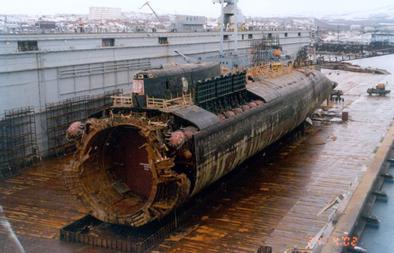 Part of salvaged wreck of
K-141 Kursk
(Source: englishrussia.com/images/kursk_submarine/1.jpg)
 (Source: englishrussia.com/images/kursk_submarine/7.jpg)
1.3 A much smaller sub
is docked across the
Arkansas River and
open for public visits
1.4 Altshuller worked as
an invention inspector
for the Soviet navy
. . . . . . Ultimately analyzed
. . . . . . hundreds of thousands of patents
. . . . . . to develop TRIZ
. . . Various organizations exist, including
2. TRIZ is a compendium
of several related
methods and approaches

Source: http://www.amsup.com/images/triz/triz.gif
(available at http://web.archive.org/web/20120307030924/http://www.amsup.com/images/triz/triz.gif)
2.2 His analysis distills down to a limited set of problems
Complete table is
39x39 engineering parameters
40 kinds of solutions
. . . see
www.mazur.net/triz/contradi.htm
(full table)
2.3 Example:
. . .cans
. . .want to improve parameter #4?
. . . . . ."Length of nonmoving object"
. . . . . .Why might we want that?
. . . . . .What problems might be caused?

. . .conflicts include #11:
. . . . . ."tension, pressure"
. . . . . .(wall is now weaker
. . . . . .in the middle)
. . .solutions are:
. . . . . .principles of invention:
1, 14, 35
(three out of the 40)
. . .principle 1:
. . . . . .Segment it
make can shorter
make lots of little walls
(corrugate it)
put circular ridges
. . .principle 14:
. . . . . .Spheroidality
(add curvature)
round the edges
cars use curved sheet metal
a flat strip is very bendable!
. . .principle 35:
. . . . . .Change physical or chemical state
use a stronger metal alloy
use thicker & heavier sheet metal
3. More modernized tables
. . .Let's try another one together:
. . . . . .need to pick an object
. . . . . .pick a row for improvement
. . . . . .pick a column showing conflict
. . . . . .identify cell with principles
. . . . . .look up the principles of invention
. . . . . .apply them!
(for example, cell phone repairability, or battery capacity, or whatever we want)
We could break into groups of 1-2-3-4...
Each try one
Then report to class
Use
table of improvement+conflicts
list of principles
===========================================================
Background: recall -
The table of
39 characteristics
that may be improved
and may conflict
. . . (see e.g.
http://www.triz40.com/aff_Matrix_TRIZ.php)
Recall:
What are the
40 Principles of Invention
in TRIZ?
1.2 . . . . . . At 20 he invented
a way to escape
from submarines
. . . . . . . . . (This did not help
the crew of
the Kursk)
. . . . . . . . . . . . length:
154 meters
How long is that?
. . . . . . . . . . . . (just under 1/10 mile)
. . . . . . . . . . . . height:
four stories
(not quite as tall as
the EIT building)
. . . . . . . . . . . . The Kursk
was the world's
biggest attack submarine
. . . . . . . . . . . on August 12, 2000 a fuel explosion
sank it
(Altschuller had died in 1998)
Hitting the sea bottom
caused torpedoes
to explode
Some crew
survived both explosions
but perished later
without escaping
Goodbye notes
were found
K-141 Kursk
(Source: englishrussia.com/images/kursk_submarine/1.jpg)

1.3 A much smaller sub
is docked across the
Arkansas River and
open for public visits
1.4 Altshuller worked as
an invention inspector
for the Soviet navy
. . . . . . Ultimately analyzed
. . . . . . hundreds of thousands of patents
. . . . . . to develop TRIZ
. . . Various organizations exist, including
- Altshuller Institute for TRIZ Studies
- The TRIZ Journal
- Oxford Creativity
- The International TRIZ Association
- ICG Training and Consulting
- Technical Innovation Center, Inc.
of several related
methods and approaches
Source: http://www.amsup.com/images/triz/triz.gif
(available at http://web.archive.org/web/20120307030924/http://www.amsup.com/images/triz/triz.gif)
2.1 Let's do a quick web search on:
TRIZ
See triz.org for a video
(Oops! - down 3/12/2020, problematic 3/11/21, don't see 3/10/22)
Some other videos:
- Altshuller preface
- Modern intro
- ...or just search youtube for "TRIZ"
2.2 His analysis distills down to a limited set of problems
Complete table is
39x39 engineering parameters
40 kinds of solutions
. . . see
(full table)
2.3 Example:
. . .cans
. . .want to improve parameter #4?
. . . . . ."Length of nonmoving object"
. . . . . .Why might we want that?
. . . . . .What problems might be caused?
. . .conflicts include #11:
. . . . . ."tension, pressure"
. . . . . .(wall is now weaker
. . . . . .in the middle)
. . .solutions are:
. . . . . .principles of invention:
1, 14, 35
(three out of the 40)
. . .principle 1:
. . . . . .Segment it
make can shorter
make lots of little walls
(corrugate it)
put circular ridges
. . .principle 14:
. . . . . .Spheroidality
(add curvature)
round the edges
cars use curved sheet metal
a flat strip is very bendable!
. . .principle 35:
. . . . . .Change physical or chemical state
use a stronger metal alloy
use thicker & heavier sheet metal
3. More modernized tables
- This one is more computerized
- interior cells list engineering principles...
- ...for resolving the conflict
- Automated lookup interface:
- http://triz40.com/ works (as of 3/10/22)
- because 40 principles of invention
- ...in addition to the 39x39 table
- https://firefly-consulting.com/triz/ works now (2022)
4. Another example
. . .Let's try another one together:
. . . . . .need to pick an object
. . . . . .pick a row for improvement
. . . . . .pick a column showing conflict
. . . . . .identify cell with principles
. . . . . .look up the principles of invention
. . . . . .apply them!
(for example, cell phone repairability, or battery capacity, or whatever we want)
We could break into groups of 1-2-3-4...
Each try one
Then report to class
Use
table of improvement+conflicts
list of principles
===========================================================
Background: recall -
The table of
39 characteristics
that may be improved
and may conflict
. . . (see e.g.
http://www.triz40.com/aff_Matrix_TRIZ.php)
Recall:
What are the
40 Principles of Invention
in TRIZ?
. . . (see e.g.
http://www.triz40.com/aff_Principles.htm)
We considered these
...for resolving engineering conflicts
...from the table
We can also think about them
....with respect to the
evolution of any technology. . .
For example:
consider some
inventions that
have room to grow
http://www.triz40.com/aff_Principles.htm)
We considered these
...for resolving engineering conflicts
...from the table
We can also think about them
....with respect to the
evolution of any technology. . .
For example:
consider some
inventions that
have room to grow
2022 topics:
Artificial Intelligence and the Future of Work (OA)
Automation (AT)
Space Travel and Colonization (& Damage to Host Planet) (JB)
Software that Answers Questions About the Future by Processing the Weboverse (JC)
Flying Cars (CH)
Cybernetic Enhancement (BM)
Dream House (CP)
Metaverse (Virtual Environment) for Everyone (PS)
Responding to First Contact (JS)
General topics:
E-readers
LED lights/lighting in general
Smartphones
Home robots
Gaming devices
or pick anything you like
 (Source: http://inshadesofscarlet.blogspot.com/#!/2010/09/lightbulbs-seriously.html
We could apply various of the 40 principles to each of these
Another idea:
Do this with
a device or technology
of specific interest
to each person
(Example:
your project topic)
1) "Segmentation":
break something unitary
into parts, modules, pieces, etc.
E.g. replace large truck
with a
tractor+trailer design
(is that good?)
LED lights/lighting in general
Smartphones
Home robots
Gaming devices
or pick anything you like

We could apply various of the 40 principles to each of these
Another idea:
Do this with
a device or technology
of specific interest
to each person
(Example:
your project topic)
1) "Segmentation":
break something unitary
into parts, modules, pieces, etc.
E.g. replace large truck
with a
tractor+trailer design
(is that good?)
2) "Taking out":
remove a part
E.g. put a
noisy air compressor
outside the building
where the air is used
E.g. Use the
bark but not the dog
as part of a burglar alarm
3) "Local Quality":
make something that is
uniform, nonuniform
E.g. refrigerator with
freezer,
moist cold bin for veggies,
dry cold bin for meat, etc.
4) "Assymetry":
make something that is
symmetric, assymetric
E.g. make a round rod
have a flat part
so a knob can
turn it without slipping
5) "Merging":
assemble similar objects
into a larger assembly
E.g. make a
network of PCs
E.g. 3 wheels are
more stable than 2 are
more stable than 1
You can get
"emergent properties"!
6)"Universality":
make one thing
do more than one thing
E.g. pencil can
erase,
store,
attach
as well as write
7) "Nested Doll":
(like those Russian dolls)
E.g. set of measuring spoons
8) "Anti-weight":
counter heaviness
with flotation
E.g. non-sinking boats;
balloons;
airplane wings and
boat hydrofoils
9) "Preliminary anti-action":
counter bad effects
of good things
ahead of time
E.g. lead aprons at the dentist
E.g. slow-release medications
10) "Preliminary action":
do something to an object
before it is needed
E.g. put glue on paper before selling it
. . . Stickers!
. . . Tape!
E.g. sterilize surgical instruments
for next time - autoclaves, etc.
11) "Beforehand cushioning":
have backup systems
present in case of failure
E.g. emergency parachutes,
fire escapes,
parking brakes
12) "Equipotentiality":
compensate for gravity
E.g. spring-loaded
cafeteria dish dispenser
13) "The other way round":
reverse the action;
go upside down;
make something fixed, movable
make something movable, fixed
E.g. rotate part instead of tool;
treadmills;
escalators
14) "Spheroidality":
change from
flat or angular
surfaces
to curved
E.g. domes and arches;
ball-point pens instead of quills
15) "Dynamics":
make it
movable
or
flexible
E.g. adjustable car seats;
medical scopes in flexible tubes
16) "Partial or excessive actions":
Do a little too much or too little, then fix
E.g. put a bit too much on your plate,
then leave a little;
almost fill your tank,
then top off
17). . . . . . "Another dimension":
use the 3rd dimension or 4th, etc.
E.g. 3D TV;
add wings to car;
2-sided screen;
double toothbrush;
dump truck
18) "Mechanical vibration":
cause oscillation/vibration
E.g. electric hedge trimmer/carving knife;
gall stone destruction;
ultrasonic neurostimulation
19) "Periodic action":
keep repeating
E.g. hitting nail with hammer;
warbling siren
20) "Continuity of useful action":
eliminate breaks
E.g. night light;
auto time sharing
(zip cars)
21) "Skipping":
do it so fast
that harm is averted
E.g. flash freezing;
heated ice cream scoop
22) "Turn Lemons into Lemonade":
use bad effect
for a good purpose
E.g. make/save money
by recycling
. . . (reuse blank side; sell cans)
23) "Feedback": improve performance by examining the effects
E.g. hard to spend
UALR budgeted money
in late spring;
cruise control
24) "Intermediary": link/separate 2 things with a go-between
E.g. potholder;
nailset;
shuttle diplomacy
25) "Self-service":
something serves itself
E.g. fertilize with grass clippings;
mow the leaves instead of raking
pot liquor to improve flavor
26) "Copying":
save with inexpensive copies
E.g. VR instead of reality;
photos;
music on CD instead of live, etc.
27) "Cheap short-lived objects": throw it away afterwards
E.g. paper plates;
disposable diapers;
anyone remember returnable bottles?
28) "Mechanics substitution":
get rid of moving parts or other objects
E.g. CD instead of vinyl record
. . . (what next? After that?);
acoustic pet fence
29) "Pneumatics and hydraulics":
use gas or liquid
instead of solid parts
E.g. gel-filled footwear soles;
natural gas instead of logs
30) "Flexible shells and thin films":
get rid of heavy, solid things
E.g. paper instead of slates;
whiteboard wall covering
instead of solid slate blackboards;
balloons
31) "Porous materials": make nonporous things, porous
E.g. save weight by making it fluffier
32) "Color changes":
change color or transparency
of object or environment
E.g. use red light to
see nocturnal critters
in a zoo
E.g. use differently colored markers
for writing
33) "Homogeneity":
make interacting objects of the same material
E.g. cut diamonds
with diamond dust
E.g. make artificial organs
out of person's own cells
34) "Discarding and recovering":
it disappears or changes itself
E.g. biodegradable plastic bags;
35). . . . . . "Parameter changes":
change properties of a substance
E.g. heat food to cook/kill germs
36) "Phase transitions":
E.g. freeze liquid center,
then dip in warm chocolate
E.g. air conditioning works
by vaporizing/condensing
a liquid
37) "Thermal expansion":
things expand/contract with temperature
E.g. make thermostats that
bend and curve
as temperature changes
38) "Strong oxidants":
use oxygen-enrichment
E.g. medical use;
match heads;
rocket fuel
39) "Inert atmosphere": use chemically inactive stuff
E.g. store priceless artifacts
in argon or nitrogen
E.g. add filler
when making pills
so you can pick them up
40) "Composite materials":
use multiple materials in a substance
E.g. fiberglass;
reinforced concrete
People could work another example individually...
Recall -
table of improvement+conflicts
list of principles
3. Other aspects of TRIZ
- (can also apply to
your project topics)
. . . One aspect:
the natural evolution
from doing one key task
and "branching out"
. . . . . . first pencils wrote
then they "branched out"
soon they erased, too
and clipped on
and stored
and didn't need sharpening
and arguably even
used ink not lead
stored documents
will play videos
. . . . . . From keyboards
to foldup keyboards,
ergonomic keyboards,
what other kinds?
. . . . . . How have
cell phones
branched out?
. . . . . . This also explains
"bloatware"
. . . . . . Have cars branched out?
. . . . . . Can you think of
something that
has not
branched out much?
4. Also from TRIZ:
usability,
aesthetics
become factors later
. . . Early cars:
"you can get any color car
you want as long as it's black"
Example, anyone?