Welcome to Spring semester 2020!
This is the course website for the course Information, Computing and the Future.
Please see the tabs for important pages, such as the syllabus.
Tuesday, January 21, 2020

Thursday, May 2, 2019
How Predictable is the Future of Solar Energy?
Reference: JD Farmer and F Lafond, How predictable is technological progress? Research Policy, 45(2016):647-665, www.sciencedirect.com/science/article/pii/S0048733315001699

Farmer and Lafond's Figure 1.
Is solar exponential? Nuclear? Coal?
Problem: Why Moore's law?
Answer (partial at least):
Next year's value is often this year's value + a percentage
Why?

Analogy: what is the rate of water evaporation?
But the percentage increase is very noisy
- Dr. S invents a new advance
- Recession holds back progress
- Companies merge/go out of business
- Government policies do whatever
- Etc.
How to model that along with %/year increases?
- Geometric random walk
- This captures:
- The trend (geometric - discretely exponential)
- The noise (random walk)
- Add in autocorrelation
- Models that the noise changes slowly
We can now figure:
the distribution of possibilities at a given future time
- See Farmer and Lafond, equations (1) through (16)! ☺️

Farmer and Lafond's Fig. 10.
What is the probability of being below the dashed line?
What is the probability of prices stalling until at least 2028?

Image source: https://en.wikipedia.org/wiki/Standard_deviation
Remember the Cone of Uncertainty concept?

Farmer and Lafond's Fig. 11:
"Probability that solar photovoltaic modules become less expensive than a hypothetical competing technology C whose initial cost is one third that of solar but is on average not improving..."
Cognitive Enhancement
Drugs that enhance normal
mental functioning are possible
Stimulants often improve performance
You can call it "doping"
Just like in sports
Maybe we wish it weren't so!
|
Substance, etc.
|
Main action
|
Mediating mechanism
|
|
Nicotine
|
Increase concentration (etc.)
|
Increase acetylcholine (etc.)
|
|
Strychnine
|
Stimulant
|
Block glycine receptors
|
|
Caffeine
|
Stimulant
|
Decrease tiredness
|
|
Hydromel (unfermented)*
|
Increase available energy
|
Raise blood sugar
|
|
Sage
|
Improve memory
|
Inhibit cholinesterases
|
|
Chewing gum
|
Improve memory
|
Uncertain
|
|
Modafinil (Alertec, Provigil)
|
Maintain alertness
|
Anti-sleepiness
|
|
Alcohol
|
Enhance creativity
|
Improve incubation phase
|
|
Methylphenidate (Ritalin)
|
Improve focus
|
Stimulate central nervous system
|
|
Amphetamines
(Adderall)
|
Improve focus
|
Stimulate central nervous system
|
|
Piracetam
|
Enhance cognition
|
Increase brain metabolism
|
|
Hydergine (ergoloid mesylates)
|
Enhance cognition
|
Increase brain metabolism
|
|
Donepizil (Aricept)
|
Improve memory
|
Inhibit cholinesterases
|
|
Cortactin
|
Enable neural plasticity
|
Circumvent calcain biomolecules
|
|
Magnesium threonate
|
Enhance learning & memory
|
Increase synapse plasticity
|
|
Insulin-like growth factor 2
|
Improve memory
|
Enhance memory consolidation
|
|
Metformin
|
Improve learning
|
Stimulate neurogenesis
|
|
Exercise
|
Enhance cognition
|
Stimulate neurogenesis
|
|
Afternoon napping
|
Improve learning
|
Clear hippocampal input queue
|
|
NgR1 antagonist
|
Enhance neural plasticity
|
Reduce demyelination; increase synapse turnover
|
|
Fish, except fried
|
Uncertain
|
Increase brain tissue volume
|
|
Klotho
|
Enhance cognition
|
Side effect of life extension
|
|
GLYX-13
|
Improve memory
|
Acts on brain’s hippocampus
|
|
|
|
|
Table 1. Some cognitive enhancement substances and
activities. (Not recommended for use nonmedical use)
There are basically only a
few strategies for cognitive enhancement
- Stimulation.
- Coffee or any other stimulant makes the brain, or parts of the brain, work harder.
- Neuroplasticity.
- Learning requires updating the neural connections, so ways of making these connections change faster can speed learning.
- Augmentation.
- Brain augmentations could work via anything from chips inserted in the brain to hats with embedded electrodes.
- Bootstrapping.
- If you learn something, then you are smarter. Called “education,” this is not the “easy way” to enhanced cognition — but in the long run may be the most effective.
- Health care.
- Innumerable health related issues, mental and physical, can reduce cognitive performance. Fixing them will thus improve cognition.
Let’s look at some examples next.
Transcranial Electrical Stimulation (TES)
- Pills take at least a few minutes
- Raw electricity...
- Fast. The call it "juice" for a reason
- Electricity applied directly to the head!
- Typically 1-2 mA
- Electroshock therapy: around 800 mA
- In 1883,5 Sylvanus Thompson described connecting a battery to the forehead to cause a “wild rush of colour”
- He did not claim to have tried it himself
- but he didn't say he didn't
Numerous studies have shown TES to be able to improve
performance in normal people on a wide variety of cognitive tasks related to
language, arithmetic, learning, skill acquisition, and planning.
You can get TES devices commercially
with a doctor’s prescription.
You can even build your own TES machine on the
cheap from do-it-yourself plans.
DBS:
For more focused application, insert electrodes into brain
Promising results for:
Depression
Parkinson's disease
Obsessive-compulsive disorder
Using it instead for brain enhancement: a no-brainer?
2011: found to make mice smarter
So why not rats?
So why not humans in the rat race of life?
TMS
transcranial magnetic stimulation
No need for pesky wires in the skull!
An approved treatment for
depression
Can lead to hypomania
Is that a problem?
People with
hypomania are energetic and elated, which can be a kind of cognitive
enhancement.
Ultrasound
Another method uses
ultrasound, or sound waves above the audible range of frequencies.
Visual hemispheric invocation
(VHI)
To invoke the right hemisphere, simply focus
your eyes on a point, while focusing your attention on something to the right
of that point in the peripheral visual field.
A better method?
A tried-and-true method for
cognitive enhancement is to associate with others with whom you have similar
goals and interests. Sometimes called the “critical mass” effect, anyone who
has been in such a group can vouch for its effectiveness.23
Thursday, April 18, 2019
Thursday, January 31, 2019
HW due days - what would be best?
HW1 was due on class day.
Is that ideal, or would another day be best for future HWs?
Is that ideal, or would another day be best for future HWs?
Thursday, January 24, 2019
Welcome to Spring, 2019!
You are looking at the website for
Information, Computing and the Future
- This page is for announcements, new items, and other chronological postings
- it is a blog!
- Yes, the course website is built on a blog platform
- The "Home" tab, above, goes to this page
- See the "Course Guidelines" tab above
- It goes to a page with general information about the course
- See the "Topic List and Syllabus" tab above
- It goes to the schedule of activities
- Also, it has links to notes and other class content
- See the "HW" tabs
- They go to the homeworks
The world is changing
Be alert to what could happen to help prepare!
Monday, December 3, 2018
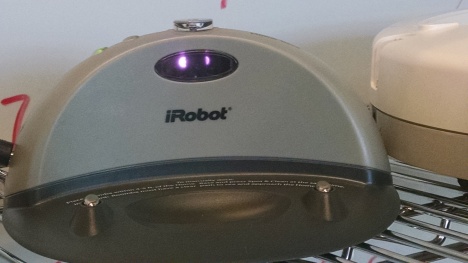
Setting up your computer to talk to a robot
First, log in
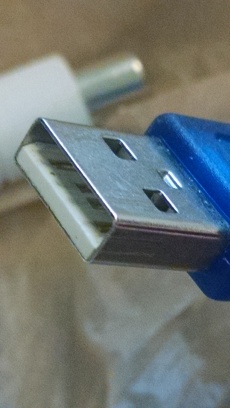
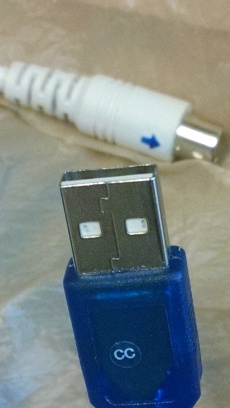
Second, plug in the cable
Third, wait 60 seconds
Let’s explain what you’ve just done
Note that some sockets look a bit like USB but are not USB
White insulator inside USB plug should face toward front of classroom
Feel free to walk around the table to see what you’re doing
Let’s explain the cable structure
Ok, we already did!
But let’s explain why
Fourth, run realterm
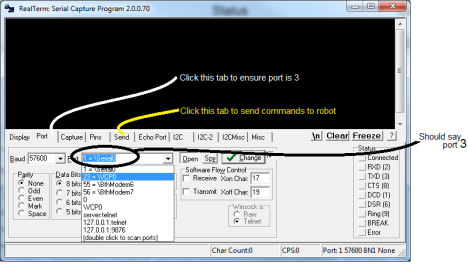
Fifth, let’s get to the robots!
Tuesday, November 7, 2017
From Centralized to Decentralized Societies
1/13/2018: found the source file and stored it in
courses-b7-14-16\informationComputingAndTheFuture\Content\lectureDecentralizedSocieties-WFS2013based
2017 updates:
I must have archived the source file of the talk at home so could not update it directly
So, I list the major updates here
Update 1: What happens when the lights go out
Remember Hurricane Irma and Puerto Rico
This is a "mild" example of the dangers of centralized electricity
Note:
PR is *much* better able to function without electricity than, say NYC!
Update 2: Another recent addition to the most reputable collapse literature
Peter Turchin

With these in mind, let's go to the talk
courses-b7-14-16\informationComputingAndTheFuture\Content\lectureDecentralizedSocieties-WFS2013based
2017 updates:
I must have archived the source file of the talk at home so could not update it directly
So, I list the major updates here
Update 1: What happens when the lights go out
Remember Hurricane Irma and Puerto Rico
This is a "mild" example of the dangers of centralized electricity
Note:
PR is *much* better able to function without electricity than, say NYC!
Update 2: Another recent addition to the most reputable collapse literature
Peter Turchin
With these in mind, let's go to the talk
Subscribe to:
Posts (Atom)